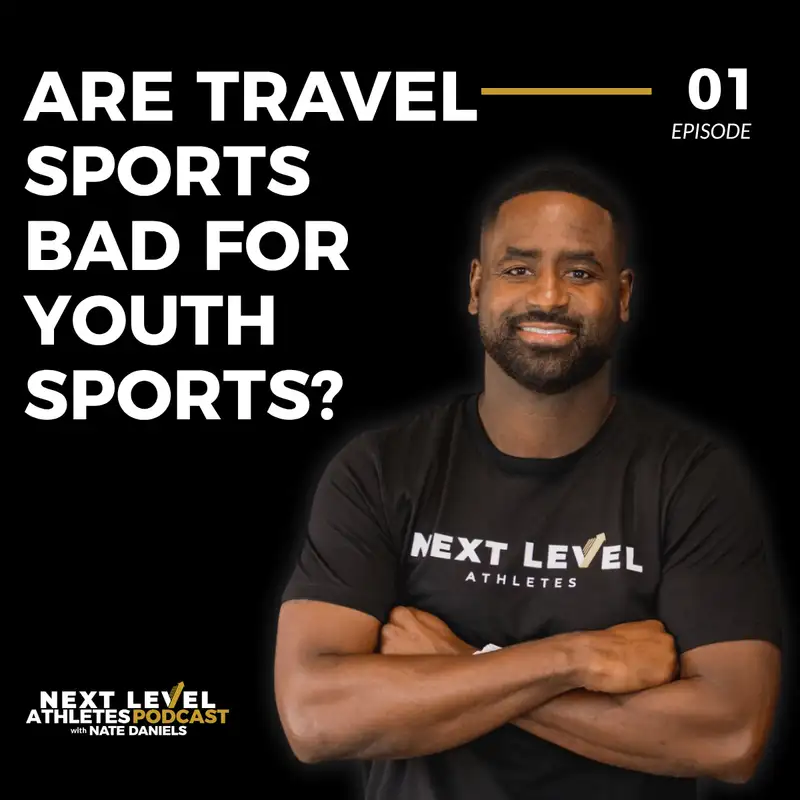
Are Travel Sports Bad for Youth Sports? [Episode 1]
Next Level Athletes Podcast
Episode 1: Are Travel Sports Bad for Youth Sports?
[00:00:00] You've seen the headlines. You've heard it at the fields, in the gyms, and on social media. Travel sports are bad for youth sports. But are travel sports truly bad for youth sports? The answer is no. Travel sports are not inherently bad. Travel sports done the wrong way are bad for youth sports. If you look at the premise of what travel sports is supposed to be about, it's supposed to be about better instruction, more training, and playing with and against better competition.
If you're trying to be the best athlete you can be, this is a good thing. But unfortunately, travel sports has become about way more than that. So, let's talk about it. Real stories, real insight, real talk about what it takes to reach the next level. This is the Next Level Athletes Podcast with Nate Daniels.
Today on Next Level Athletes, we're getting into travel sports for youth athletes, the good, the bad, and by the time we're done, [00:01:00] you're going to have a completely different lens on what travel sports actually is and exactly what you need to do to successfully navigate it. Let's get into it. Travel sports has turned into a billion-dollar industry.
You've got families spending five, 10, 15,000. I've trained AAA hockey players that have spent up to $30,000 a year chasing sometimes an undefined dream. You've got kids burning out at 13 years old because they've specialized too early, played 11 months out of the year. You have parents sitting in the bleachers absolutely convinced that their kid is a Division I prospect when the coaches on the sideline see something completely different.
That's the broken side of travel sports, and none of that is meant to scare you away from travel sports. It's meant to do exactly what this podcast is built to do, give you the full picture, because the families who struggle in travel sports aren't [00:02:00] struggling because travel sports is broken. They're struggling because no one sat them down before they signed up and said, "Here's what you're actually walking into.
Here's what to watch for. Here's how to protect your youth athlete and your family as you go through this experience." That conversation starts right now. Let's break down the real issues, because when you have the knowledge, you can navigate the whole journey differently. You can see the traps before you fall into them.
You can ask the right questions before you write the check, and you can show up for your athlete in the way that actually moves them forward instead of holding them back. First, let's discuss parent expectation. When parents are paying, and in travel sports, parents are paying a lot of money, expectations come with that.
That's human nature. You invest money, you expect a return on that money, and that's actually where things start to go sideways because that financial investment [00:03:00] starts to quietly shape everything, playing time, positions, roster decisions. Suddenly, parents aren't just watching their kid play. They're mentally calculating whether they are getting what they paid for.
That entitlement is real. I see it on every level, and I'm not saying it because it makes you a bad parent. I'm saying it because it's a trap that easily parents fall into, and no one warns you about it prior. But here's where it gets really important. If you are entering travel sports with the expectation that your investment is going to end with a full-ride athletic scholarship for your athlete, I need to clarify this for you.
That's not what this is. The numbers don't lie. Only approximately 7% of high school athletes go on to play college sports at any level. That's D1 through D3, JUCO, NAIA combined, 7%. A college scholarship is not a return on investment. It's [00:04:00] a possible outcome for a small percentage of athletes who developed the right way, they were extremely talented, and they were very fortunate to stay injury-free, and at the end of that journey, a scholarship was awaiting them.
And the families who are going in it treating it like a business transaction are the ones who end up burned out, bitter, and broke, wondering what went wrong. Go in as an investor in your child's development, not an investor expecting a financial return. Next, too many games, not enough development. While we're talking about development, here's the promise of travel sports.
Your athlete is going to compete at a higher level against better competition and get better because of it And, that sounds great, but the reality of how most travel programs operate tells a different story. Travel sports by design is built around tournaments, [00:05:00] weekends, games, and parents love games.
Parents want to see their kids play. That's why they drove three hours and paid for hotel bills, took days off of work. But here's what most parents don't understand. Games do not develop athletes. Practice develops athletes. Training develops athlete. Competition reveals what's been built through training and development.
It doesn't build it. The most elite development programs in the world across every sport are built around practice, repetition, skill work, and intentional coaching, not just game volume. When your athlete is playing 60, 70, 80 games a year, sometimes up to 100 games a year, they're not getting 80 to 100 opportunities to develop.
They're getting 80 to 100 opportunities to repeat whatever habits, good or bad, that they've already developed in training. Ask any club or organization about their practice to game ratio [00:06:00] before you write the check. Because if the answer is mostly tournaments with a practice here or there, you're paying for exposure that your kid may not be ready for.
Next, early specialization. The message that's being sent to families, sometimes directly, sometimes through the culture, is if your kid isn't specializing at seven, eight, nine, 10, then they're going to be falling behind, and it'll be too late to catch up. But I'm here to tell you that is absolutely not true, and the data backs that up.
Because when you specialize too early, doing the same movement patterns, it leads to repetitive motion injuries. Working the same muscle groups with the same physical demands year-round with no breaks, overuse injuries skyrocket. We're seeing stress fractures, tendonitis, growth plate issues in kids who haven't finished developing physically yet.
And it's not just a physical toll. Early specialization brings pressure. When a child's entire athletic identity is [00:07:00] wrapped up in a single sport at a young age, every bad game, every tough practice, every moment, they struggle to carry that enormous weight. So many athletes who consistently make it to the next level, most of them played multiple sports growing up.
They developed athleticism across different movement patterns. They stayed mentally fresh. They specialized a lot later than you think. And they were better for it. Protect your athlete's body. Protect the love of the game. The specialization conversation can wait for when it actually matters. All right, now let's talk about when travel sports is everything it's supposed to be, because it absolutely can be.
When travel sports works as intended, they can provide many benefits and opportunities for youth athletes. So when do travel sports actually work? It works when the goal is development, not destination. The families I've seen navigate this the best, they're not in travel sports to get a [00:08:00] scholarship or to go pro.
They're in it to develop their athletes. The scholarship, if it comes, it is a byproduct of genuine development. When development is the goal, the pressure changes. The conversation changes. It's about getting better from day to day. The whole energy around the sport when destination is not the goal changes.
The priorities change for the parents and the athlete. It works when the organization prioritizes the athlete. Not all clubs and organizations are created equal. And I want you to really hear that because the logo on the jersey and the tournament schedule does not tell you what you need to know about any program.
There are coaches and programs out there who genuinely care about developing young athletes and young people, who put the player's growth first over wins and losses, who communicate honestly with families, who hold athletes to standards that build character. Those programs [00:09:00] exist, and they're worth searching for.
The way you find them isn't by looking at their record. It's by watching how long their players have been in the programs, the general consensus and feedback from other parents about their experiences, not just the disgruntled ones. Their philosophy on development, playing time, positions, rotation, and the practice to game ratio.
Also, it's worth noting that you need to vet the coaching staff. Are they knowledgeable? Do they communicate well? Do they build great rapport with their players? Are they coaches that the players will want to learn from, lean on, confide in, and grow with? It works when the family is in alignment. The athlete wants to be there, not because mom and dad want them to be there, but because they genuinely want to be there.
The parents are in a supportive role, not a coaching role. Everyone in the household has had honest [00:10:00] conversations about what this commitment actually costs, the money, the weekends, the logistics, the emotional energy, and they've decided together that it's worth it and it's for the right reasons. That alignment is rarer than it should be.
But when it's there, you can feel it. Those families are a joy to be around. And those athletes, they perform differently because the environment around them is healthy and focused on the right things.
Real Talk From The Sidelines
All right. This is one of my favorite parts of the show. This is real talk from the sidelines. Real questions from real parents who are in the trenches right now.
And this week's question comes from a sports parent with a challenge I hear from families all the time. Whether your athlete plays soccer, basketball, volleyball, baseball, this is a situation is going to sound familiar. Before we get into it, if you have a question that you would like answered on this show, send us a voice note.
Find out how to send it to us in the show notes. This week's question comes from Jessica in [00:11:00] Pittsburgh. Hey, Coach. This is Jessica from Pittsburgh. I'm looking for some advice on the next steps on my daughter's athletic journey. She's a rising eighth grader and currently plays for a lower level club in our neighborhood, but she's really not being challenged there.
She does have the opportunity to play for both her age group and the one above, so she gets a lot of playing time, and she loves the coaches, her teammates, the organization, and to be honest, it's pretty easy on our budget compared to some of the other local clubs. But next season, she has the opportunity to try out for an ECNL team, and we're trying to decide should we keep her at her current club and push for more individual training combined with, you know, a lot of game time playing that she still already kinda gets.
Or do we make that jump to the ECNL team, really not knowing, you know, what the playing time looks like and really not having much time for additional individual training on the side? As a mom, I feel [00:12:00] like going into eighth grade, it's a really crucial year before high school. So I'd love to know your thoughts on the best way to proceed and, you know, move forward with her career.
Thanks for the help. Thank you, Jessica. That's a great question, and I agree with you 100%. Eighth grade is a very critical and crucial year of development for these athletes as they enter into high school. My goal for any sports parent or any athlete is to do everything in your power to be varsity ready as a freshman.
Now, does that mean you're gonna be varsity ready? That depends on so many variables that we don't really know about right now. What kind of personnel is at the high school, right? What is the program philosophy of the coaches? What positions do your kids play as far as the personnel that matches up with what's already at the high school?
But that's nor here nor there. We still want to make sure that we are varsity ready, meaning physically we are varsity ready, meaning we are athletically qualified to play at that level [00:13:00] strength-wise, speed-wise, endurance-wise, all of the physical attributes that it would take to compete at the varsity level.
Then technique and fundamentally-wise, we need to make sure that our technique and fundamentally is sound so we can compete at that level against big, strong, and faster players. You're talking about a age gap of sometimes up to three to four years, depending on how old your freshman is. Now, how do we ensure that our kid is varsity ready or as close to varsity ready as possible when they enter in high school?
We have to play against the best competition possible while balancing individual development, whether that be skill work or strength, um, strength and conditioning development. Now, going into an unknown, to answer your question specifically about jumping to the next league, going into an unknown is always a scary endeavor for the athlete and scary for the parents because moving from something that is known to unknown is always you're unassured or [00:14:00] you may not know what's going to happen, but you have to believe in yourself.
You have to believe in your talent. You have to believe in the work that you put in, and you have to believe in the process. The only way to grow as a person or as an athlete is to challenge yourself. Once you have taken that challenge, you can then assess how your athlete is progressing along. First of all, are they enjoying the experience?
Are they getting the playing time that's needed to develop? And even more importantly, are you still having time to develop that athlete technically and fundamentally and also, uh, physically? So with all that being said, I feel that you should take on that next challenge because this is eighth grade and we're making that transition to try to make this young lady as varsity ready as possible, and the only way we can do that is to make sure that we're playing against the best competition possible.
I hope that helps. Let's bring this home with something that's not talked about enough in the world of travel sports. Checking in with yourself and your athlete, not just at the beginning when the [00:15:00] excitement is high, but throughout the journey. So I want to give you five check-in questions, not to second-guess yourself, but to help you stay grounded, stay realistic, and actually enjoy this journey.
Come back to these questions every year when something feels off. Number one: Do we still know why we're doing this? Not why you started, why you're continuing right now, this season. The clearer your family is on the purpose behind the commitment, the better every decision gets. If your answer has shifted from, "We're here to develop our athlete," to, "We've already invested so much, let's just keep going," that's worth paying attention to.
Number two: Is your athlete still loving the game? Not loving every moment, that's not realistic, but underneath the hard practices and the tough losses and the competitive pressure, is the love still there? Check in with your athlete, and not with just, "Did you have fun [00:16:00] today?" Have real conversations. What do they love specifically right now?
What's hard right now? What are they looking forward to? The love of the game is the most valuable asset your athlete has. It will carry them through setbacks, injuries, and adversity in ways that talent alone never will. Protect it fiercely. Number three. Is our family healthy in this? Travel sports touches everything.
Your finances, your weekends, your relationships, your stress levels, the energy inside your home on game days. So ask yourself honestly, is your family healthy in this experience? Are you enjoying the journey together, even in the hard times? Or has this quietly become a source of tension, resentment, anxiety that no one is talking about out loud?
Healthy families produce healthy athletes. The environments you create at home is part of your athlete's development, [00:17:00] whether you realize it or not. Number four. Is this environment still the right fit for where your athlete is right now? Not where they were when you signed up, where they are right now.
Athletes develop. They outgrow programs. They outgrow groups. Sometimes they need more challenge or less challenge. Sometimes the coaching style that worked at 10 isn't what works at 14. Give yourself permission to evaluate this regularly without guilt. Loyalty to an organization is admirable, but your first loyalty is to your athlete's development.
If you can come back to these questions every season and answer them honestly, you are going to navigate travel sports differently than most families around you.
And if you want a guide to help you do exactly that, I put together the Travel Sports Game Plan, a guide for parents who are invested in their athlete's future but want to make sure they're spending their time, money, and [00:18:00] energy in the right places.
It covers everything. How to evaluate programs, what actually develops athletes, how to handle playing time How to build a long-term plan for your whole family and your athlete. This is a game plan every family in travel sports should have because it's practical and it can save you a whole lot of heartache.
Grab your copy of the Travel Sports Game Plan at the link in the show notes. Here's what I want you to walk away with. Travel sports are not bad. Travel sports, if done the wrong way, are bad for you sports. The families who win in travel sports are the ones with the clearest vision, the healthiest perspective, and the willingness to put their athlete's long-term development above short-term results.
That's what this podcast is about every single week. If this episode gave you something, a new way of thinking, a conversation to have, a question to ask, do me a favor. [00:19:00] Subscribe to the show and your favorite listening platforms and leave a review. Every review helps us reach more sports parents and families just like you.
I'm Nate Daniels, and this is the Next Level Athletes podcast. I'll see you on the next one. Welcome to the next level.